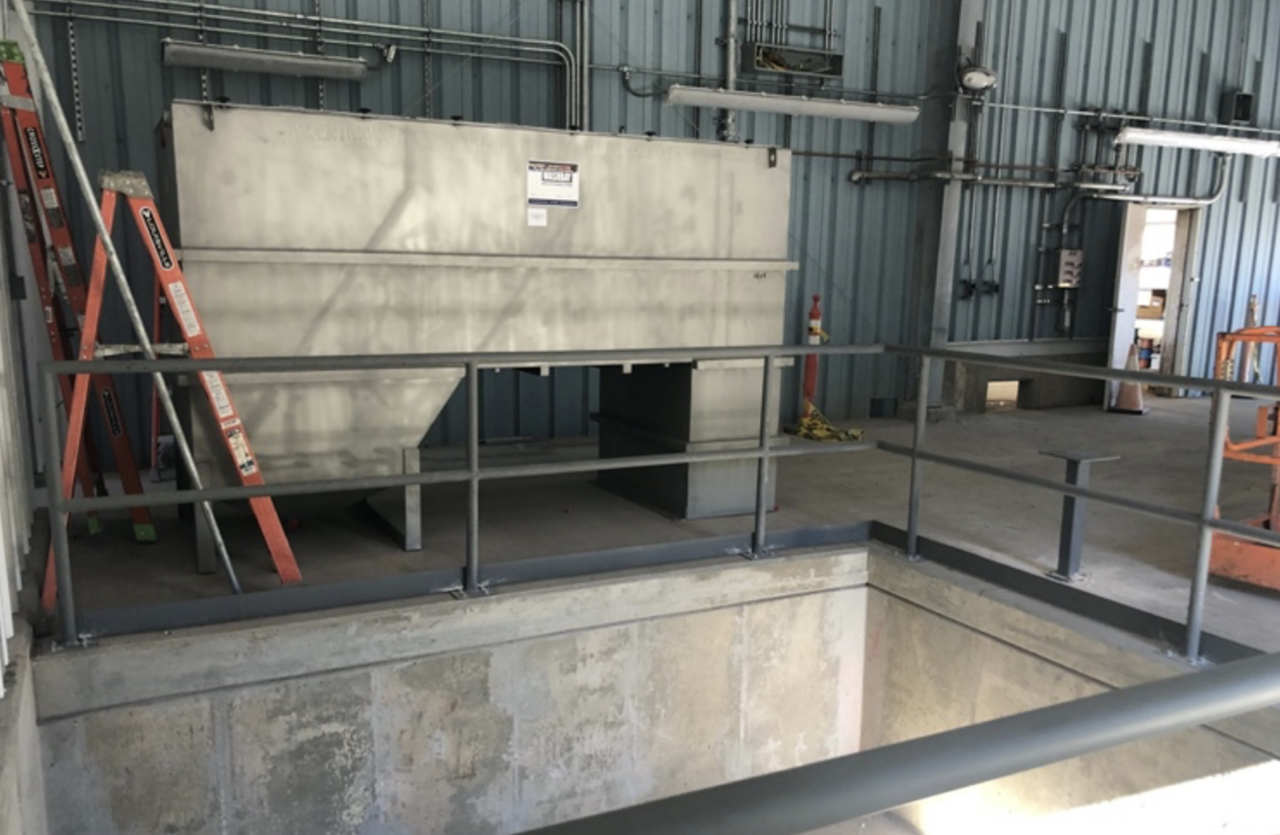
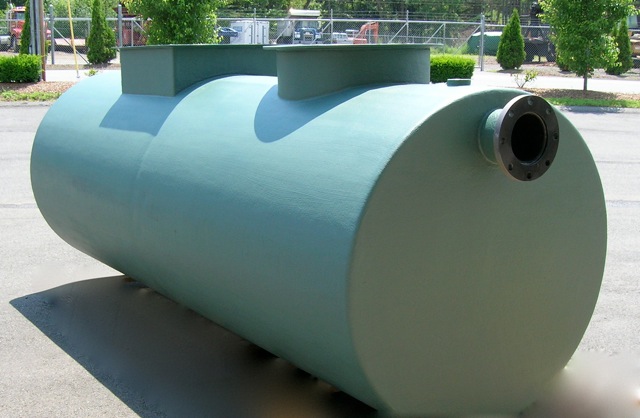
Above-ground oil/water separators offer ease of maintenance and visual inspection, while below-ground separators are preferred for space constraints and potential spill containment. Above-ground units are typically easier to access and maintain, often involving simple cleaning with a hose or pressure washer. Below-ground systems can leverage gravity for inlet flow and may be necessary in areas with limited space or existing infrastructure.
The following comparison highlights the key pros and cons of above-ground and below-ground oil/water separators.
Above-Ground Oil/Water Separators
Below-Ground Oil/Water Separators
Pros
Ease of Maintenance: Above-ground units are easily
accessible, allowing for simple cleaning and inspection.
Visual Inspection: The location allows for easy
monitoring of the separator’s performance and any potential issues.
Greater Variation: Systems can be for particular application with different sizes and options.
Cost-Effective Maintenance: Maintenance is often less expensive
than underground systems.
Pros
Space-Saving: Minimizes the use of valuable surface space
Gravity Flow: Gravity can be utilized for wastewater inlet, reducing the need for pumps and controls.
Ideal for Large Flow Rates: Well-suited for handling high
volumes of oily wastewater.
Suitable for Spill Containment: Can be designed for spill
containment in various applications, such as vehicle maintenance.
Cons
Space Requirements: Require more surface space than
below-ground systems.
Pumping Requirements: May require pumps and control systems to transfer wastewater into the separator, which adds to initial costs, maintenance and noise levels.
Potential for Unsightliness: May not be desirable in areas where aesthetics is a concern.
Cons
Maintenance Challenges: Maintenance can be more
complex and potentially hazardous due to confined space.
Potential for Leaks:Underground piping systems may be vulnerable to leaks into groundwater, requiring double-walled tanks and piping.
Higher Initial Costs: May have higher initial
installation costs compared to above-ground systems.
Our new solids settling below ground separator is ideal for any application with high concentration of solids and oil in water.
Most old conventional separators require long retention times, resulting in needlessly large units. They also have little in the way of solids settling. Our new innovative new design has both a much smaller footprint and a much higher removal efficiency for both oil and solids which lowers your total cost of ownership.
How it works:
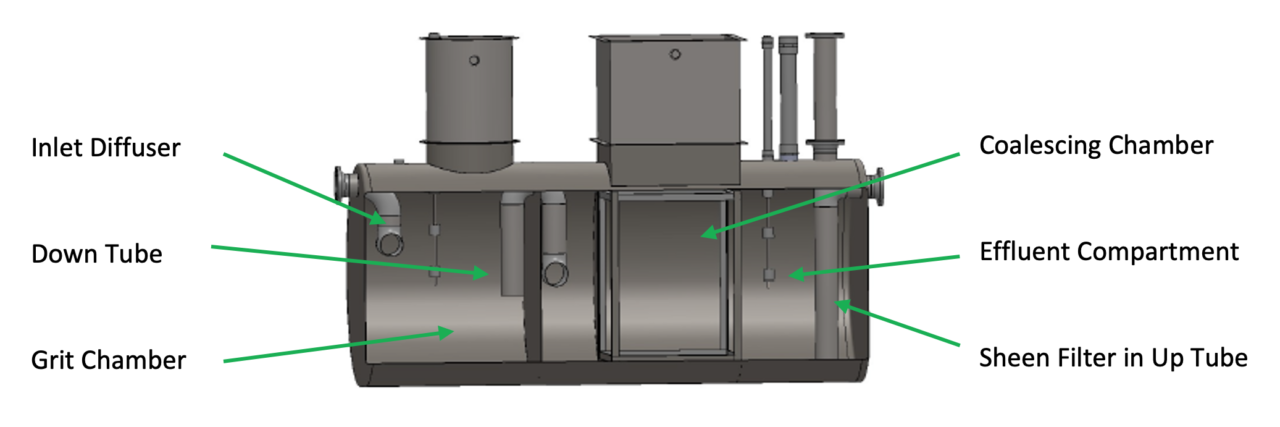
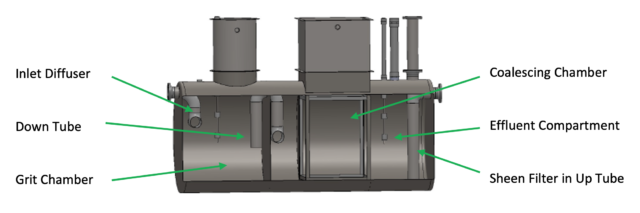
To enhance separation, these separators contain an inlet diffuser, grit chamber/inlet compartment, down tube, coalescing/separation chamber, oil storage area, effluent compartment, and sheen filter.
In the Grit Chamber, the inlet diffusor initially distributes the incoming water flow evenly over the cross-sectional area of the separator. The free oil (150 micron size or larger) is separated and the settleable solids are captured at the bottom.
The suspended solids and dispersed oil then flow upward through the down tube in the Grit Chamber, and over to another diffusor in the Coalescing Chamber.
The flow continues through the Coalescing Chamber where the coalescing plates will separate the oil droplets 30 micron size and larger up to the surface, and the remaining suspended solids will be captured beneath the coalescing plates.
Finally, a removable Sheen Filter inside the up tube in the Effluent Compartment will remove carryover, smaller droplets of oil, and mechanical emulsions.
Performance Standards
Utilizes patented, revolutionary, non- plugging coalescing plates which remove free oil droplets as small as 30 microns
Performance guarantee based on influent characteristics
Will achieve discharge of 5 ppm or less in accordance with CEN EN 858-1
Warranted for (1) year on material and workmanship and (10) years against external corrosion
Below Ground Oil Water Separator Models
Model #
Average Flow Rate (GPM)
Capacity
(Gallons)
Inlet/Outlet (Inches)
Dimensions, D x L (Feet)
WB-QB-35-ES
35
350
4
3.5 X 6
WB-QB-55-ES
55
550
4
4 X 6
WB-QB-100-ES
100
1000
6
4 X 10.75
WB-QB-200-ES
200
2000
6
5.3 X 12
WB-QB-300-ES
300
2500
6
5.3 X 15
WB-QB-400-ES
400
3000
8
5.3 X 18
WB-QB-500-ES
500
3800
8
6 x 17.5
WB-QB-600-ES
600
4000
10
6 x 18.75
WB-QB-700-ES
700
7000
10
8 X 18.67
WB-QB-800-ES
800
7000
10
8 X 18.67
WB-QB-900-ES
900
7000
12
8 X 18.67
WB-QB-1000-ES
1000
7500
12
8 X 20
WB-QB-2000-ES
1200
8500
12
8 X 22.5
WB-QB-1500-ES
1500
12000
16
10 X 20.75
WB-QB-2000-ES
2000
14000
18
10 X 24
WB-QB-2500-ES
2500
17000
18
10.5 X 26.5
WB-QB-3000-ES
3000
19000
20
10.5 X 29
Call Now to Speak with a Oil Water Separator Specialists – 1-800-453-8639!
Our single wall or double wall below ground parallel, corrugated plate oil/water separators meet and exceed API 421 requirements, removing essentially 100% of dispersed non-emulsified oil droplets in the waste stream.
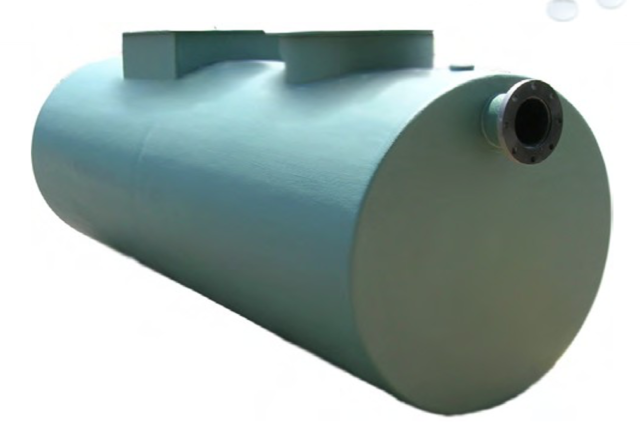
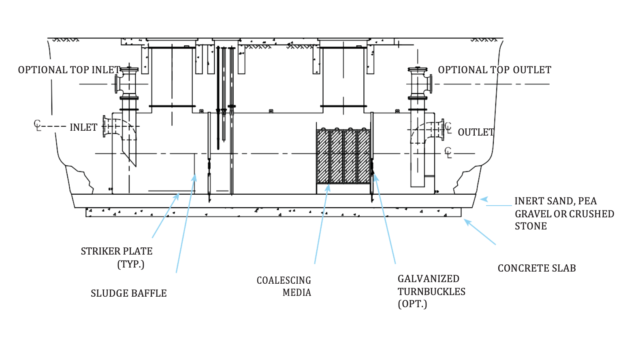
These separators are special purpose prefabricated parallel corrugated plate, cylindrical, gravity displacement oil water separators, containing an inlet compartment, sludge chamber, separation chamber, oil storage area and clean water compartment.
As shown below, the separation process if fairly simple. Wastewater flows into the inlet compartment. A baffle interrupts the flow and allows solids to drop out. Next the oil water moves into the separation chamber where our innovative media causes small oil droplets entrained in the water to coalesce into larger ones which then separate from the water and float to the surface. The clean water then travels into the clean water compartment through the outlet to the sewer.
Features
Patented, revolutionary, non- plugging coalescing plates which remove free oil droplets as small as 20 microns
Single wall or double wall construction with interstitial space for leak detection
Rectangular access manhole with 3’ extension to service and maintain coalescing media
Fittings for vent, oil pump out, sludge pump out, gauging and lifting lugs
Exterior sandblasted and coated
Will achieve discharge of 5 ppm or less in accordance with CEN EN 858-1
Warranted for (5) years on material and workmanship and (30) years against external and internal corrosion
Construction in accordance with UL58 and corrosion protection in accordance with UL1746
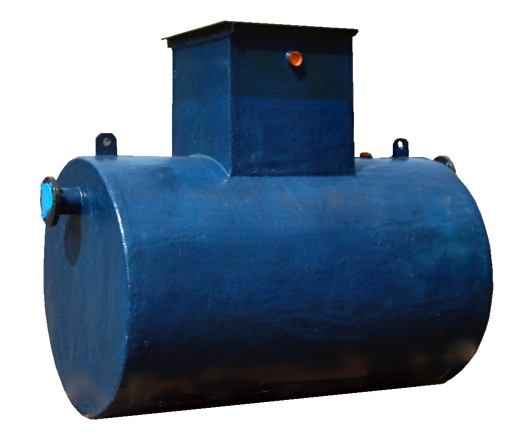
Featuring one of our oil water separator designs to be placed under ground.
Options
Internal coating for corrosion protection
Grit chamber for high solids applications
Hold down straps
Leak and Level detection systems
Applications
Parking Lots
Re-fueling Facilities
Marinas
Military Installations
Truck and Equipment Washes
How does it work?
Analysis
With these separators, we can provide analysis, which indicates that the separator will be provided with the required square feet of projected plate separation area to achieve the specified performance under laminar flow (i.e. Reynolds Number of less than 500) conditions. This service can include calculations signed by a registered professional engineer.
Our stormwater oil water separators will remove solids and all free and dispersed non-emulsified oil droplets 20 micron or greater in size and produce an effluent discharge of less than 5 PPM.
The first phase of a rainstorm can be deceiving. The peaceful melody of the droplets can quickly disperse over parking lots, fueling depots, and washing areas that all contain pollutants, such as oil and grease. Because impervious surfaces do not allow rain to infiltrate into the ground, storm water runoff is generated. Surface runoff or storm water runoff then becomes a major threat to our nation and our clean water supply.
In order to protect our clean water supply these waters have to be treated before being discharged from storm sewers to surface waters. Our WB-QB oil water separators will remove solids and all free and dispersed non-emulsified oil droplets 20 micron or greater in size and produce an effluent discharge of less than 5 PPM.
Most municipalities have storm water departments that are made to protect water resources and reduce impacts from storm water runoff. They also are responsible for the compliance of requirements for the National Pollutant Discharge Elimination System (NPDES) permits.
Our efficient, below ground separators meet pretreatment SPCC and NPDES permits for local communities.
Our proprietary design incorporates patented revolutionary non-plugging poly-propylene coalescing plates. Our coalescing media exceeds all known American performance standards including UL 2215, and has been tested in accordance with European Union Standard CEN EN858-1, which requires a discharge limit of less than 5 PPM. Our separator tanks are manufactured to UL 58 and UL 1746 Standards. Construction can be either single wall or double wall with a corrosion protection system. Sizes are available up to 4000 GPM flow rate.
Operation Maintenance
All models can be serviced from grade level
No confined spaces
Plates easily removed, washed down and put back in place
Solids can be pumped out through large access opening from grade level
Options Available
Grit chamber for solids removal prior to coalescing compartment
Effluent pump out chamber after coalescing compartment
Oil stop valve to retain lighter liquids from leaving separator
In many cases, a below ground oil water separator is the best option due to space restrictions and layout. You can use gravity to drain into a below ground system and then into the sanitary sewer system so there is no need for pumps and controls. In other cases, a below ground system has been previously specified and it is not possible to change the specifications.